
Russell 2000 (IWM) technical forecast: Triple top for bears or bullish breakout
- Russell 2000 (IWM), the broadest market index, is lagging.
- Nasdaq makes more record highs but it needs support.
- Russell (IWM) is stuck in a range and needs to move.
For a broader more comprehensive view of the market, the Russell 2000 (IWM) is a good proxy given it makes up 2000 stocks, while the Nasdaq and Dow are narrowly concentrated. The dow is practically invitation only with just 30 stocks, the Nasdaq has the top 100 and even the S&P is a bit narrowly focused with 500 stocks. Apologies if this is a bit obvious but we try and cater to a broad range of traders here at FXStreet and some may have dipped across from FX and not be too familiar with the makeup of the main US equity indices. So we have now established that the Russell is the broadest measure of the overall US equity market, how is it performing? Well, it is frankly lagging and needs to pull its socks up before it pulls everything down. The Nasdaq has recently taken on a leadership role and outperformed the other main indices for June. Reversing its underperformance earlier in the year. We have mentioned previously, but the inflation and yield fear that spooked markets have subsided. The US 10-year yield was heading for 2% but has now retreated and appears to be planning a quiet summer below 1.5%. The Fed did its best to convince markets that inflation will indeed be transitory to use its own language. Whether this pans out or not has yet to be seen and the latest inflation data, US PCE, and wholesale prices hit multi-decade highs.
But for now, markets have put inflation worries to the back of their minds which allowed the interest rate sensitive Nasdaq to surge. Apple (AAPL) had been slumbering but has recently put in a nice move (see here) and Tesla (TSLA) too, has turned things around, surging through some key levels (see here). Facebook (FB) joined the $1 trillion dollar club, Microsoft (MSFT) joined the $2 trillion dollar club and Alphabet (GOOGL) set more record highs.
But can all this Nasdaq boom continue while other stocks and indices are left in the dust? The chart below shows us the relative performance of the main indices since April. The Russell (IWM) underperformed in May along with the Nasdaq but by early june had caught back up. But this trend has resurfaced in late June for the Russell but the Nasdaq has surged to new highs. So will the Russell play catch up or is it signaling to us that things are about to turn?
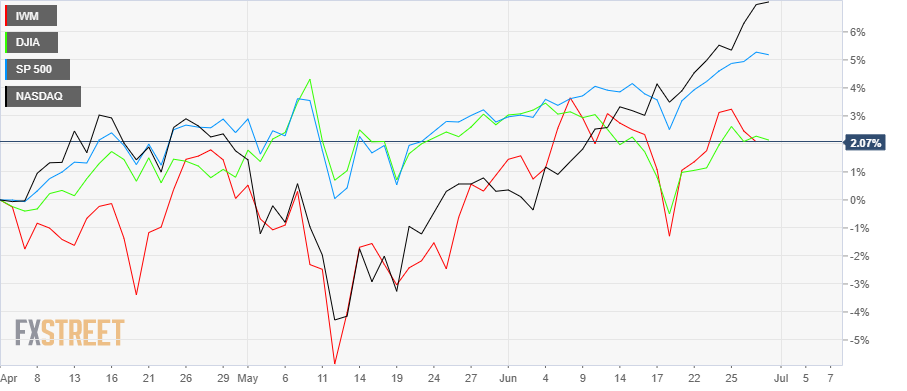
Russell 2000 (IWM) forecast
Just a quick word on the relative means of trading the Russell Index. For analysis, we are using the Exchange Traded Fund (ETF), ticker IWM as opposed to using the futures contract, ticker RTY. Both are more or less mirror images.
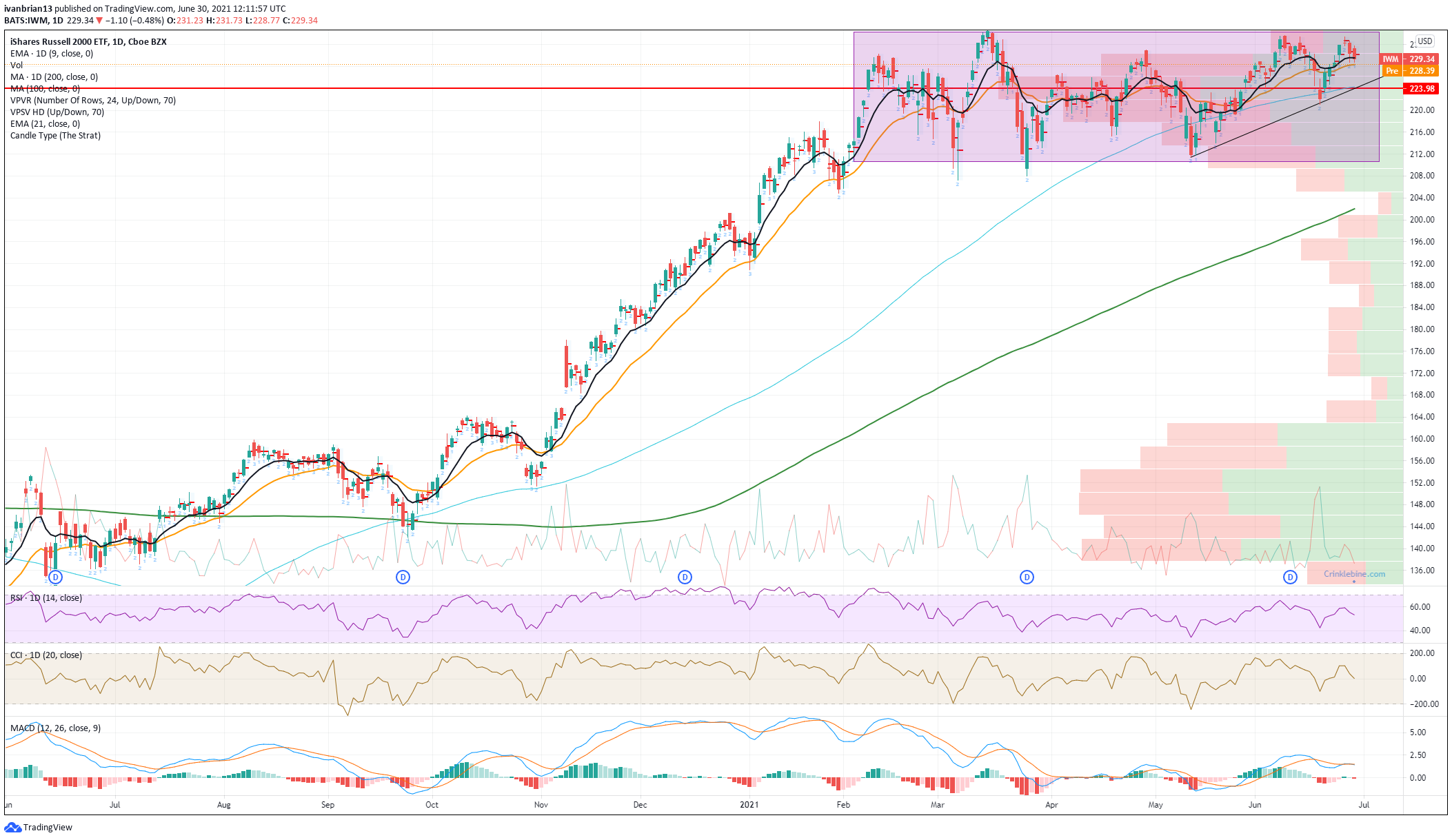
From the chart below we can see the large, effectively sideways range the Russell has traded in since, well since 2021 basically. While the other indices have proudly been showing off regular new highs, the Russell appears unloved. This cannot continue forever at some stage something has to give. We pointed out in our analysis of the S&P 500 on Tuesday (see here) that the Nasdaq RSI (Relative Strength Index) had crept into overbought territory and that remains the case. The delta variant is also growing in spread and causing fresh lockdowns in parts of Asia and a delay to reopening of economies in some EU countries. Finally, we identified the VIX at low and slumber levels but Tuesday saw a modest 3% spike to 16.5 not huge, but worth watching.
So no strong trend in evidence for the Russell (IWM) to fall back on. The 9 and 21-day moving averages are flat lining as is the MACD (Moving Average Convergence Divergence). The RSI is trending lower. Breakouts can be powerful trades to jump on and if the Russell does manage it then expect a strong continuation. $234.53 remains the high and breakout from March. A retracement to $205 could get ugly due to a lack of volume beneath. Putting in a retracement here would mean a bearish triple top.
Like this article? Help us with some feedback by answering this survey: